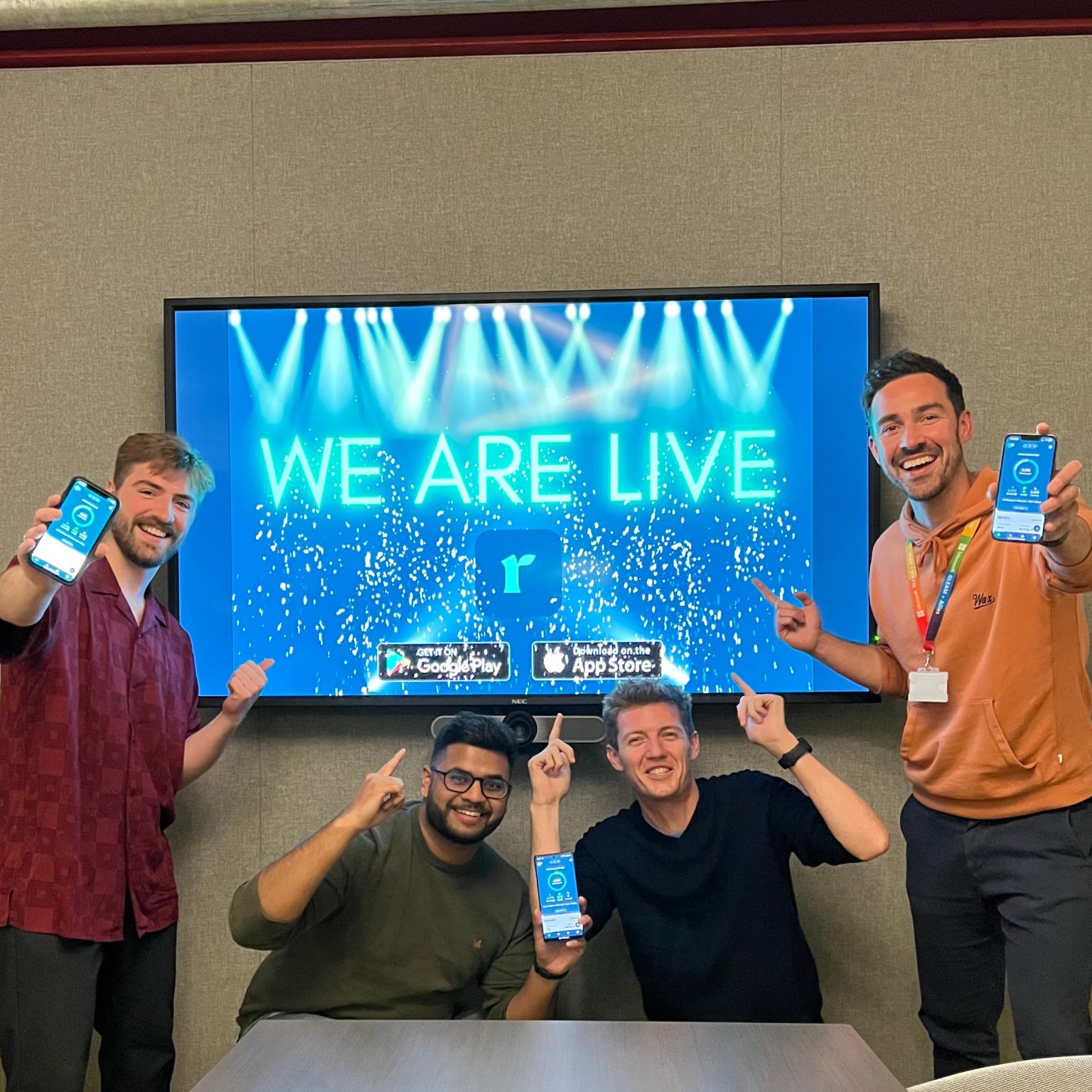
Jun 2023The Reewild app goes live
We are live.
A carbon-tracking app modelled on Strava, MyFitnessPal and Fitbit — the first shipped product.
Platform · iOS & Android
Product · Reewild — carbon-tracking app
Moment · The first shipped product
Launch day · the founding team, moments after the app went live
What we launched with
A carbon tracker in the shape of a fitness app.
Reewild launched as a consumer app that helped people understand and reduce the environmental impact of the food and drink they bought. The mental model was borrowed openly from the fitness world: measure a habit, feed the number back to the user, and let the loop do the work.
01
Strava
Every activity captured, streaks compounded, community as fuel.
02
MyFitnessPal
Log the input, see the score, learn what "good" looks like over time.
03
Fitbit
Passive tracking behind the scenes, gentle nudges when it mattered.
The bet was that if people could see the impact of a choice clearly, they'd choose better. The direction was right. The mechanism we'd chosen would need work.
What we found
Sustainability behaviour is not calorie behaviour.
Calories are personal, immediate and self-affecting. Carbon is diffuse, delayed and other-affecting. The number that motivates a user to change their lunch order isn't the number that changes what they do at the supermarket.
What we saw over the first months of use was that transparency alone didn't create momentum. Users understood their impact. They agreed with the direction. They just didn't compound the behaviour the way a fitness user compounds a run streak.
Information doesn't create momentum. Knowing something is better doesn't mean it adds up.
The instinct at the time was to add more measurement. In the months that followed, that instinct got tested — and the thinking started to move.
What we started noticing
People had changed. The system hadn't.
Around the same time, everywhere we looked, consumers were behaving differently. They were paying more for better food. Choosing resale over fast fashion. Spending more intentionally. Thinking harder before checkout.
And yet loyalty programmes — the systems that were supposed to reward customer behaviour — still recognised the same handful of things they always had:
What loyalty rewarded
- Volume
- Frequency
- Spend
- Optimisation
- Points maximisation
What loyalty ignored
- Thought
- Intention
- Restraint
- Considered swaps
- The pause before purchase
That gap didn't feel like an environmental problem. It felt like a broader signal problem — one the team would keep chewing on for a long time after the launch.
The seeds of what came next
An early product. A long road.
The Reewild carbon-tracking app was the first thing we shipped. It wasn't the last shape of the idea — and it wasn't meant to be. The insights that would eventually define the current company took years, several product pivots and a lot of real user data to distil into something that actually worked. This page is about that first moment: what we launched with, and what we started to see once real people began using it.
Where the story picks up
Everything that follows in Building Vela — the payments-network work, the Mastercard pilot, the rebrand, the current commercial model — sits on top of what we learned in the months after this launch. That's the arc.